KUKI-LINE
Credits
Concept & direction Myriam Van Imschoot Developed during a residency at Kyushu University, Ohashi Campus, Fukuoka In dialogue with Tomoko Hojo and the Department of Acoustic Design Presented at FREQ, in a double bill with Moreskinsound by David Toop and Ania Psenitsnikova
Production newpolyponies With the support of the Flemish Commuity. Special thanks to Professor Jo Kazuhiro, Keita Hori and the FREQ team.




Info
Version 1:
KUKI-LINE is a participatory performance created for the Ohashi campus of Kyushu University in Fukuoka. Its title refers to the Japanese word kūki — air, atmosphere, but also the subtle social currents through which people read and adjust to one another.
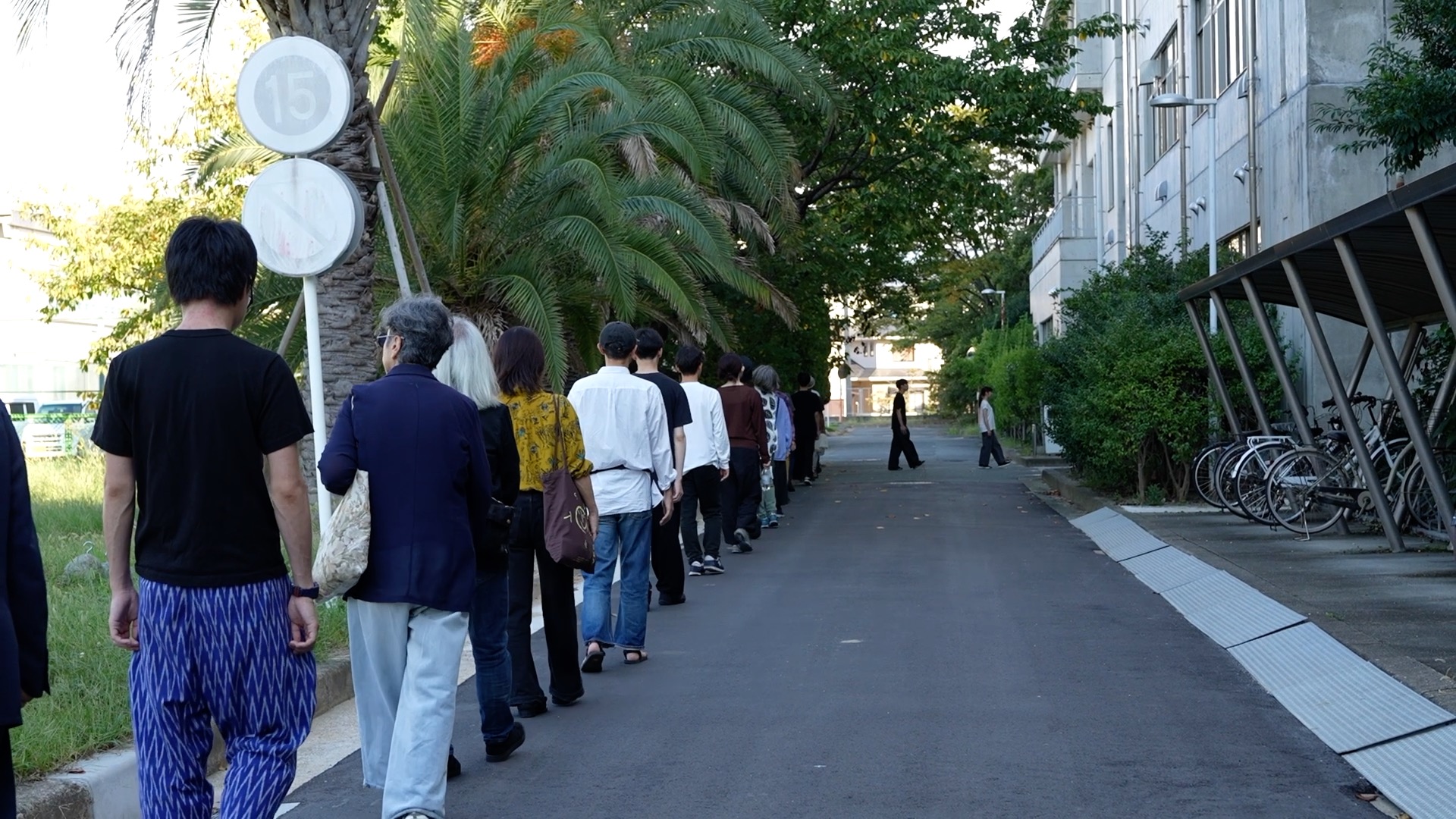
Moving through Hisao Koyama’s modernist campus from its edges towards the centre, participants form an elongated line that stretches, turns and coils as it advances. The line becomes a collective listening device: depending on one’s position, participants encounter different acoustic conditions, as sounds travel unevenly along the line and through the surrounding architecture.
At certain moments, the architecture itself is set into vibration. Walls, fences, railings and other surfaces are sounded and awakened, producing unexpected acoustic effects and revealing resonances that usually remain unnoticed. The walk concludes with a collective clap in a site marked by standing waves, briefly concentrating the dispersed listening into a single shared acoustic event.
Version 2:
Developed during a residency at Kyushu University in Fukuoka, Japan, KUKI-LINE is a performative sound walk by Myriam Van Imschoot that explores the relationship between architecture, movement, listening and acoustic activation.
The work takes its title from the Japanese notion of kuki (空気): air, atmosphere, and the subtle social currents that circulate between people. It also draws on the choreographies of queueing, crowd management and collective circulation embedded in everyday public life.
Taking the Ohashi campus complex, designed by Hisao Koyama and informed by the legacy of Louis Kahn’s Salk Institute, as its point of departure, KUKI-LINE approaches the site as both a material environment and an architectural carrier of social imagination. Through walking, listening and sounding, participants briefly reactivate ideas of openness, collectivity and social flow embedded in its design, while remaining attentive to their ambiguities and limits.
Participants traverse the campus in an elongated line. At times, the formation operates as a unified body moving through space. At others, it becomes a device for distributed perception. Maintaining measured distances from one another, the walkers move through the site together while experiencing it differently. Sounds arrive unevenly along the line; what is heard at one end may differ considerably from what emerges fifty or sixty metres further on.
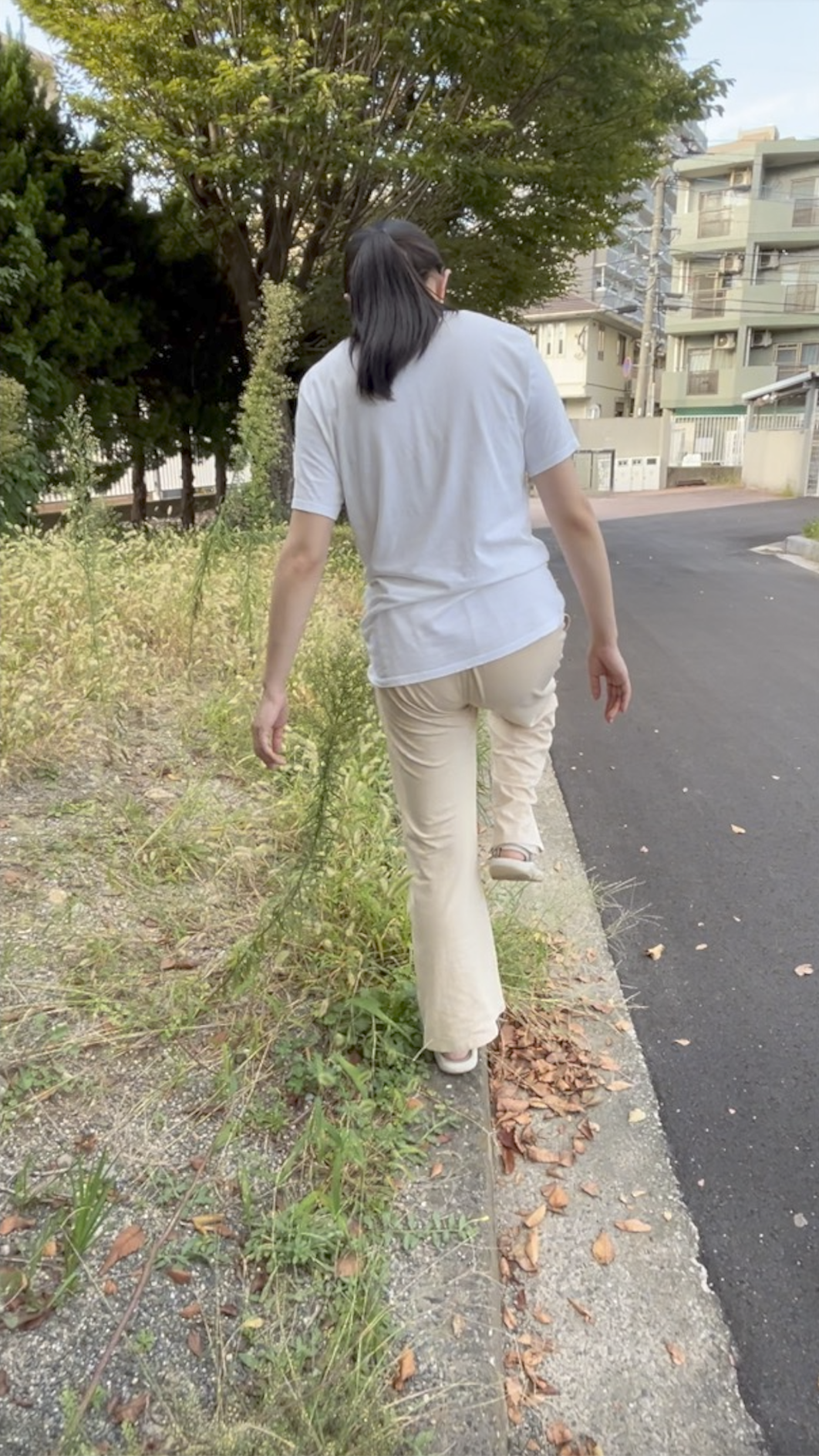
The walk moves from frayed edges, residual spaces and acoustic margins into the modernist heart of the site. Along the way, a metal rod is used to activate fences, railings and concrete surfaces. Sounds accumulate, overlap and travel unevenly through the line, gradually revealing an acoustic dimension of the campus that usually remains unnoticed.
The trajectory culminates in the natural amphitheatre known as “The Frying Pan”, where participants gather around a point capable of producing standing waves. One by one, participants offer a single clap. Resonating with Japanese practices in which a clap may conclude, acknowledge or gather collective attention, the gesture serves both as acoustic probe and ritual closure. As standing waves emerge within the amphitheatre, the architecture briefly answers back, revealing itself not as a backdrop but as an active participant in the composition.
Luisteren
Credits
Concept & direction Myriam Van Imschoot Developed during a residency at Kyushu University, Ohashi Campus, Fukuoka In dialogue with Tomoko Hojo and the Department of Acoustic Design Presented at FREQ, in a double bill with Moreskinsound by David Toop and Ania Psenitsnikova
Production newpolyponies With the support of the Flemish Commuity. Special thanks to Professor Jo Kazuhiro, Keita Hori and the FREQ team.